Spatial Decision Systems for Military Land Management
- Kevin Haynes
- Jun 15, 2023
- 3 min read

Updated: 3 days ago
Introduction

The U.S. military operates one of the largest land portfolios in the country, much of it located within ecologically significant landscapes.
As Environmental GIS Manager for the SC Army National Guard, I managed over 20,000 acres within the Cowasee Basin—a UNESCO biosphere adjacent to Congaree National Park. The challenge was persistent and structural: maintain military readiness while helping preserve one of the most biodiverse environments in the United States.
This work required more than mapping. It required building a spatial decision system capable of aligning military, environmental, and community priorities within a shared operational framework.
System Context
Military land management operates under competing constraints.
The Department of Defense cannot invest in land protection without a clearly defined mission-related need. Conservation partners require defensible evidence of ecological value. At the same time, regional growth increases pressure on both training capacity and ecosystem integrity.
Without a structured system, these priorities are difficult to reconcile. Land management becomes reactive, fragmented, and dependent on negotiation alone.
Strategic Context

Military installations increasingly face pressure from urban encroachment, climate-related environmental change, and long-term resource constraints.
Programs such as REPI—the Readiness and Environmental Protection Integration Program—reflect a broader institutional reality: land management is not only an environmental concern. It is also a readiness issue and, by extension, a national security issue.
In that context, location data is not simply descriptive. It becomes a decision infrastructure for evaluating risk, coordinating partners, and directing investment.
The Power of Location Data in Conservation
Programs like REPI demonstrate that land management is not just an environmental concern—it is a national security issue.
Intervention

I developed geospatial decision frameworks to support land management and conservation planning under the REPI (Readiness and Environmental Protection Integration) program.
This included:
Structuring spatial datasets using DoD standards
Integrating environmental, operational, and development data
Designing multi-criteria models to evaluate land suitability for conservation easements
These systems enabled coordinated decision-making across military leadership, conservation organizations, and government agencies.
The result was a system that supported coordinated decision-making across military leadership, conservation organizations, and government agencies.
System Design
Multi-Criteria Site Selection
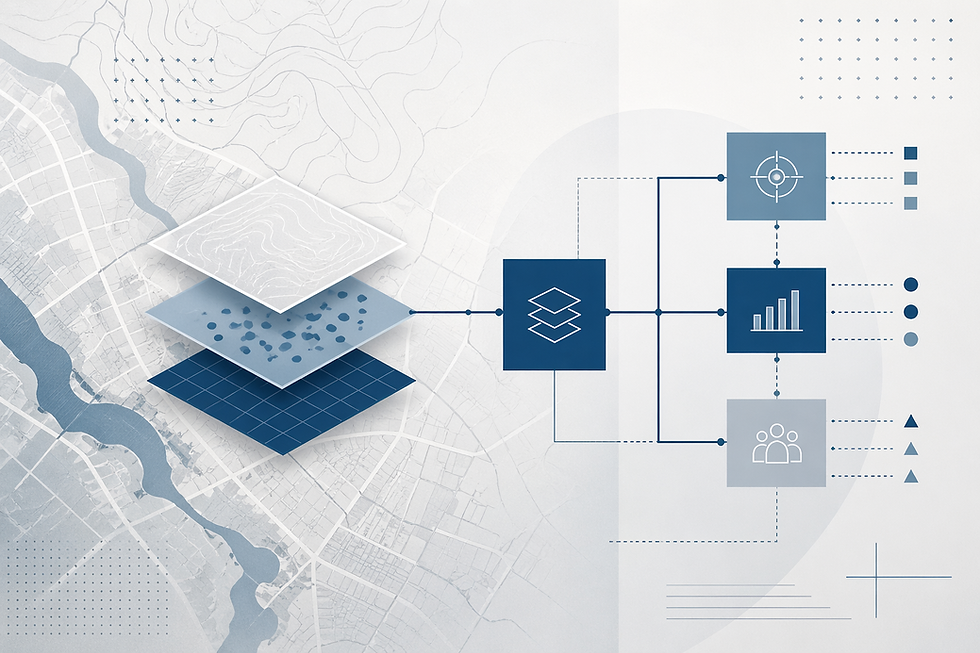
Spatial models evaluated candidate parcels using three primary dimensions: ecological significance, proximity to military operations, and development risk. This made it possible to assess conservation opportunities not only in environmental terms, but in relation to operational value and long-term land-use compatibility.
Cross-Sector Data Integration
The system combined data from military, environmental, and regional planning sources into a unified analytical structure. That integration created a shared basis for decision-making across organizations with different mandates, priorities, and evidentiary standards.
Decision Support Outputs
The analytical framework produced prioritized land portfolios that could guide conservation investment, partnership strategy, and funding justification. Rather than relying on ad hoc assessments, leadership could evaluate options through a repeatable and transparent process.
Outcomes
This work supported the allocation of more than $10 million in Department of Defense funding for conservation easements.
It also enabled coordinated land acquisition strategies across military and conservation partners and established a repeatable framework for balancing operational requirements with environmental stewardship.
This case shows how geospatial systems can function as institutional infrastructure: integrating competing priorities, structuring evidence, and guiding investment decisions across sectors.
Impact
This system transformed land management from a negotiation problem into a structured decision process.
Rather than treating military readiness and conservation as competing interests, spatial analysis made them interoperable. Leadership could justify investments that simultaneously protected training capacity, preserved critical ecosystems, and strengthened community partnerships.
The broader lesson is that spatial systems do more than organize land information. When designed well, they create the institutional conditions for better decisions across mission, environment, and governance.


Comments